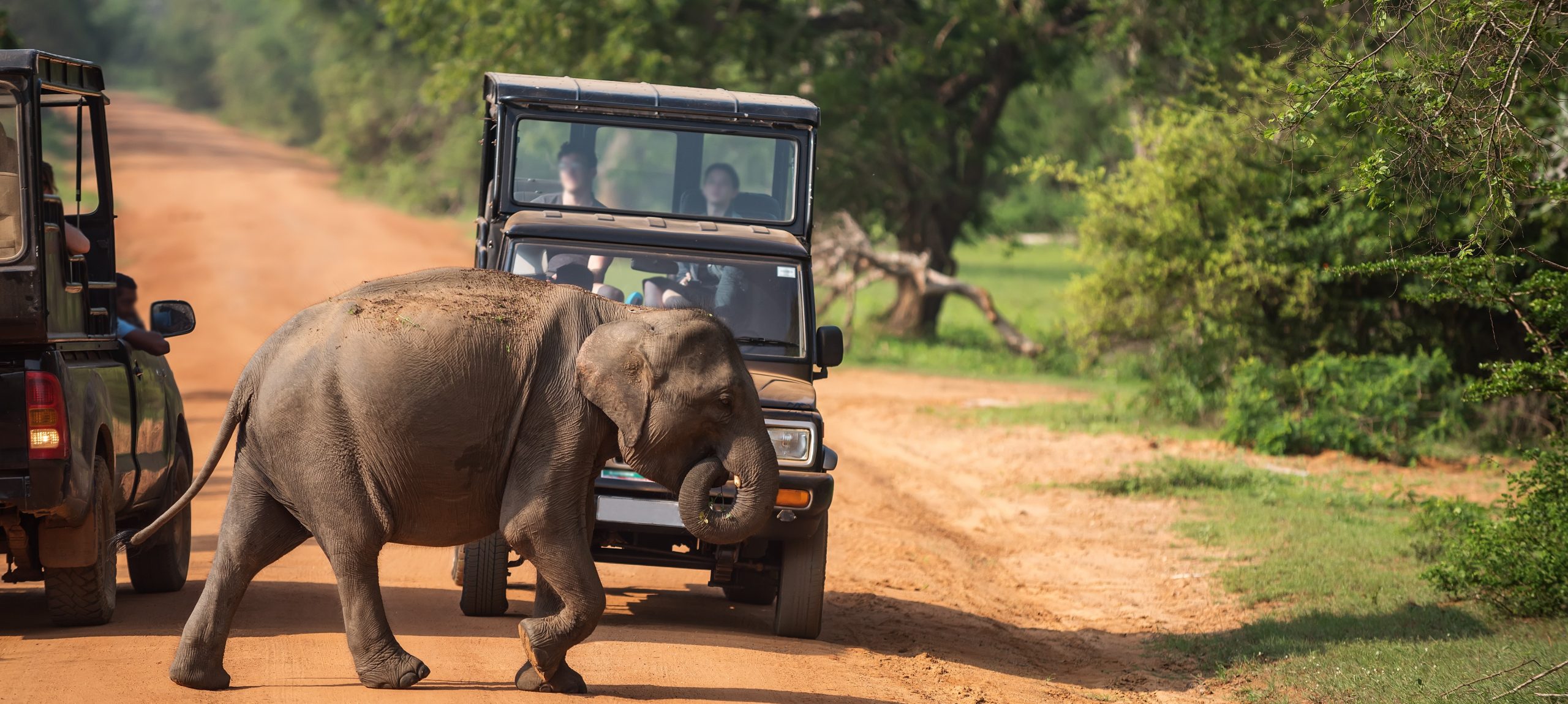
Visitor Management and Overcrowding at Yala National Park
Yala is Sri Lanka’s best-known wildlife park. It is also its most crowded and worst managed one, and its reputation for this is now damaging Sri Lanka’s tourism brand internationally. Every few years a new committee studies the same problems, writes the same list of fixes, and then very little happens. DWC has not enforced its own rules well enough.
Political Interference
Political interference is still a real problem. It has been named as the main obstacle in every review of Yala since 2017, and it still has not stopped. It needs to stop completely, not just get a bit better.
Part of the reason it keeps happening is simple: jeep driving is one of the main jobs in the area around the park. There are roughly 700 registered jeeps working out of Tissamaharama, Kirinda and Kataragama. Local politicians rely on the votes of these drivers and their families, so they often pressure DWC to go easy on the ones who break the rules. Until that pressure is taken away, no new rule will really work.
Block 1 Overcrowding
Almost all the crowding happens in Block 1, for two simple reasons:
- It is the closest block to Tissamaharama and Kataragama, so it picks up day-trippers and pilgrims heading to Kataragama, not just genuine wildlife visitors.
- Its leopards and elephants have got so used to vehicles over the years that they are easy to see, which is exactly what pulls in even more jeeps.
On a busy day, Block 1 can have 500 vehicles inside it at once, though the block was probably only built to hold something closer to 100.
Blocks 3, 4 and 5 have healthy numbers of animals too, but far fewer visitors, so their animals are still nervous around vehicles. Give them the same steady stream of visitors that Block 1 gets, and their animals will get used to vehicles in the same way, over time. Left alone, people will keep going to Block 1 out of habit. Someone needs to spread them out on purpose, and that is really what the recommendations below are about. Each block should have a specified maximum carrying capacity.
Vehicle Numbers, Zoning & Carrying Capacity
A proper study of how many vehicles Block 1 can safely hold has never been done, despite being promised since 2017. Until that is fixed:
- Vehicle entries into the busiest blocks should be cut by 10 to 20 percent a year until they reach a safe level.
- Block 1 should be split into zones, so vehicles are not all crowding the same few spots.
- Every park, not just Yala, should have its own vehicle limit for each session.
- The Ondaatje area could be opened as a special zone with a higher price and a strict limit of about 25 vehicles.
- Splitting the day into three entry times — 6 to 10am, 10am to 2pm, and 2 to 6pm — would also help, by making sure fewer vehicles are ever inside the park at once.
The simplest way to manage all of this is one online booking system that sells a fixed number of tickets for each block. As an example, Block 1 might get 150 vehicles a session, and Blocks 3 and 4 might get 50 each. Tickets would be sold first come, first served, through a simple phone app, paid by card or bank transfer. For people who do not want to book online, there should also be a ticket office in Tissa town.
Enforcement, Penalties & Compliance
When drivers and guides break the rules, there needs to be a clear and certain punishment. A multi-step system of suspensions, ending in a one-year loss of licence, should be written into law, and wardens should not be allowed to use their own judgement to let people off.
Other key steps:
- DWC needs at least one or two patrol vehicles on the road during the busiest hours, from 6 to 10 in the morning and 2 to 6 in the afternoon.
- Every jeep and driver working in the park should be registered and checked at the gate, and no new jeep should be allowed in until an old one comes off the list.
- DWC should keep a public list of drivers who break the rules, so hotels and tour companies can stop giving them work, and should also recognise the good drivers.
- Every jeep should display the park rules and a WhatsApp number, so guests can report bad behaviour straight away.
None of this will work if the park itself is not looked after properly. Right now, general upkeep is poor, and it gets worse in the monsoon season. DWC needs more money and more attention for this.
Entry, Exit & Visitor Flow
Two small changes would help straight away:
- Change the closing time from a fixed 6pm to dawn to dusk, so wardens can allow a bit more time at certain times of year.
- Let visitors come in through one gate and leave through a different one — for example, in through Palatupana and out through Katagamuwa.
Right now everyone has to leave through the gate they came in from, so at closing time every vehicle rushes back to the same spot at the same time. This is a big part of why there is so much speeding and crowding near closing. The equipment needed to track vehicles between multiple gates was given to DWC about three years ago, and it still has not been activated.
Ticketing, Pricing & Booking Systems
E-ticketing should be used for every block in Yala, not just Block 1. Prices should also go up during long holiday periods, when the park gets the most visitors, so that people are not encouraged to add to the crowd at exactly the busiest time.
There should also be a set number of tickets available for each block, so that Block 1 does not end up as overbooked as it is now. A visitor who cannot get a Block 1 slot online would simply be shown the other blocks that still have space.
Roads, Infrastructure & Habitat Management
The roads and facilities inside the park need investment:
- Speed bumps should be placed every 100 metres along any straight stretch of road longer than that in Block 1.
- Blocks 4 and 5 need more roads, and Blocks 3 and 4 need proper loop roads and new water holes, instead of the single track each has today.
- Clearing some of the thick bush along the roads would also make it easier to see animals.
- Busy parks need regular road maintenance, not occasional repairs — during the monsoon season many roads are impassable.
- Every park should have proper toilets, with at least two locations in the busier ones, and a small fee could cover the cost of keeping them clean.
Driver, Guide & Tracker Training, Accreditation and Pay
Every safari driver should complete proper training and follow a code of conduct before getting a licence, and that licence should be renewed every two years with a refresher course. Drivers and DWC guides should also get proper training in explaining wildlife to visitors, not just driving them around. Guides especially need training in how to manage a crowd at a sighting without upsetting the animals.
In the longer run, the private sector and Sri Lanka’s universities should build a proper school for training rangers and nature guides, so that local young people and drivers can get real, ongoing training and a proper certificate, not just a one-off session.
None of this will really work, though, unless pay changes too. Many drivers and trackers are paid very little, sometimes almost nothing, and depend on tips to survive. This pushes them to promise a leopard sighting no matter what, which is exactly why jeeps end up chasing animals and crowding around sightings. There should be a guaranteed minimum wage for each trip, not dependent on tips or sightings.
Diverting Demand to Alternatives
Part of the answer is outside Yala altogether. Sri Lanka’s other national parks should be properly marketed, so that some visitors choose to go there instead of adding to the crowd at Yala.
Many of the visitors to Yala are not nature lovers but sightseers — for example, people who stop in on their way from Kataragama. Sightseers like these could be encouraged to visit Ridiyagama Safari Park instead, in the Ambalantota area of Hambantota District. It is Sri Lanka’s first drive-through safari park, spread over about 500 acres, where visitors travel through in safari buses or jeeps while the animals move freely in open zones, including areas for lions, Bengal tigers, elephants and other animals.
Prioritising Longer-Stay Visitors
Because of the improved highway network, many guests increasingly come, for example, from Galle to Yala for a one-game drive and then drive on to Ella. They spend nothing staying in the local area, unlike genuine nature lovers, who might spend two or three nights in a lodge near the park.
If visitor numbers are capped block by block, people who turn up without booking ahead will simply be directed to whichever block still has space.
Private Sector Self-Regulation & Marketing
Hotels and tour companies have a part to play too. They should only hire drivers who are properly trained and certified, check on their behaviour every year, and take some responsibility themselves when a driver working for them misbehaves in the park.